Baton Rouge's humid subtropical climate and prolonged warm seasons create extended nesting periods for stinging insects across East Baton Rouge Parish. In historic neighborhoods like Spanish Town, Garden District, and…
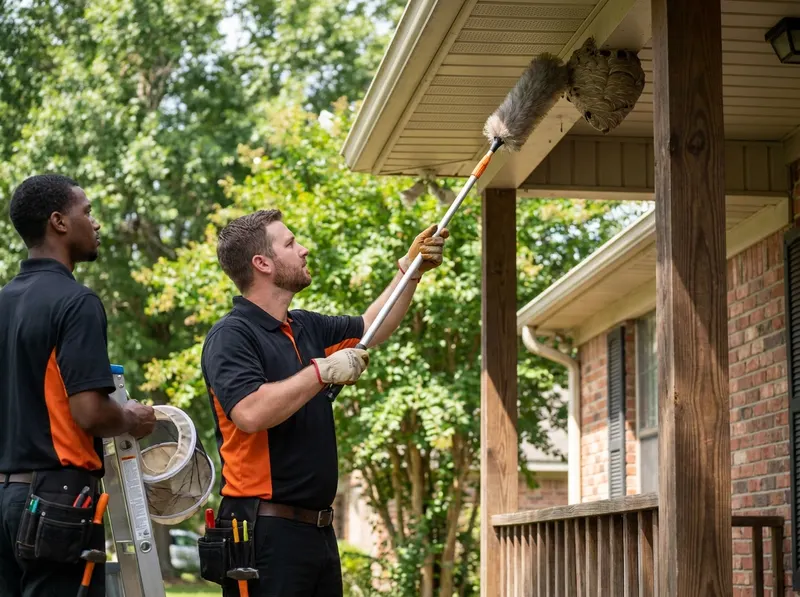
Baton Rouge's humid subtropical climate and prolonged warm seasons create extended nesting periods for stinging insects across East Baton Rouge Parish. In historic neighborhoods like Spanish Town, Garden District, and Southdowns, older architectural detailing, open soffit vents, and deep eave overhangs provide sheltered harborage for red paper wasps and European hornets. In suburban areas such as Shenandoah, Bocage, and Inniswold, large oak canopies and expansive perimeter shrubs harbor aerial bald-faced hornet nests, while mid-century brick weep holes in Mid City and Broadmoor frequently host subterranean yellowjacket colonies. These insects defend territory vigorously; defensive perimeter flight increases near entry pathways, creating significant sting hazards for children, pets, and groundskeepers.
Selecting professional stinging insect removal rather than over-the-counter pyrethroid sprays addresses colony biology rather than surface stragglers. Store-bought retail sprays discharge at short ranges and frequently provoke colony dispersion, driving defensive wasps deeper into attic crawl spaces, drywall cavities, or living areas. A targeted botanical-first Integrated Pest Management (IPM) strategy applies directional dust formulations and precision residual barriers directly into the comb matrix, neutralizing the queen and developing larvae. For honeybees nesting in structural voids near University Hills or Highland Road, structural cut-outs with live extraction preserve beneficial pollinators through licensed apiary relocations rather than chemical extermination, preventing fermenting honey from degrading wallboard.
Eradication protocols follow three distinct mechanical steps. Step 1: Technicians conduct a comprehensive 360-degree exterior inspection to track flight lines, establish the entry aperture, and determine nest depth. Step 2: The access zone is isolated, and low-toxicity microencapsulated dusts or targeted liquid active ingredients are injected under low pressure directly into the nest entrance to collapse the colony without aerial drift. Step 3: Physical comb extraction is completed where structural design allows, followed by a localized residual surface application to deter returning scout insects from re-establishing the territory. Homes bordering drainage bayous or densely planted properties like those near Independence Community Park or BREC's Baton Rouge Zoo receive exterior perimeter barrier treatments to suppress seasonal queen recolonization.
Every job gets a firm, written price after a free on-site visit.
Tell us about your stinging insect removal job in Baton Rouge and we'll send a clear, written quote, usually the same day.
 Zenvirox Pest Solutions