Subterranean termite management across East Baton Rouge Parish requires distinct methods tailored to architectural foundations and high moisture levels. In historic neighborhoods like Spanish Town and the Garden…
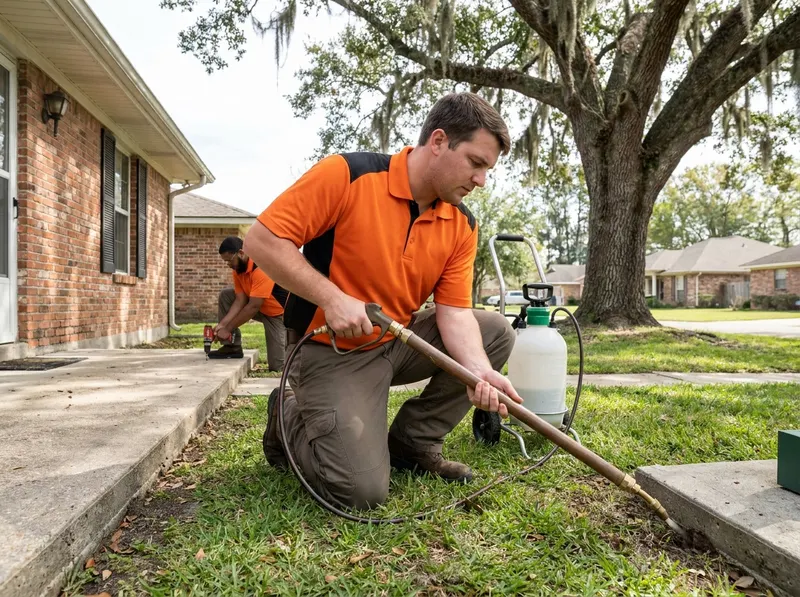
Subterranean termite management across East Baton Rouge Parish requires distinct methods tailored to architectural foundations and high moisture levels. In historic neighborhoods like Spanish Town and the Garden District, pier-and-beam construction demands crawlspace trenching around every supporting pier alongside internal perimeter soil saturation. Conversely, slab-on-grade homes in Shenandoah, Bocage, and Broadmoor rely on continuous continuous exterior barrier trenching and precise expansion-joint drilling where concrete patios, carports, or walkways meet brick veneers. Because Formosan subterranean termites build secondary aerial nests (cartons) inside wall voids when indoor plumbing leaks are present, liquid ground barriers are frequently paired with low-toxicity borate treatments directly applied to interior structural framing studs.
Selecting a liquid non-repellent barrier versus an in-ground baiting system depends on structural design and site drainage. A continuous liquid treatment saturates the exterior soil perimeter at a standard rate of 4 gallons per 10 linear feet per foot of depth, bonding to the clay-heavy soil to eliminate insects as they pass through undetectable active ingredients. The trade-off is the disruption required for concrete drilling through garages or porches. In-ground bait stations placed every 10 to 15 feet around the drip line eliminate drilling into decorative stone in developments like University Hills, Southdowns, or Inniswold, but rely on active termite foraging schedules to distribute insect growth regulators back to the reproductive queen.
Treatment execution follows four concrete steps: 1. A visual and acoustic inspection of baseboards, plumbing penetrations, and expansion joints measures active thermal and moisture signatures. 2. Technicians dig a 6-inch by 6-inch continuous trench along the exterior perimeter wall. 3. Liquid termiticide is pumped into the trench, or monitoring bait stations are cored into turf zones at 10-foot intervals. 4. Displaced soil is blended back into the trench to form a sealed, uniform defense line.
Every job gets a firm, written price after a free on-site visit.
Tell us about your subterranean termite treatment job in Baton Rouge and we'll send a clear, written quote, usually the same day.
 Zenvirox Pest Solutions